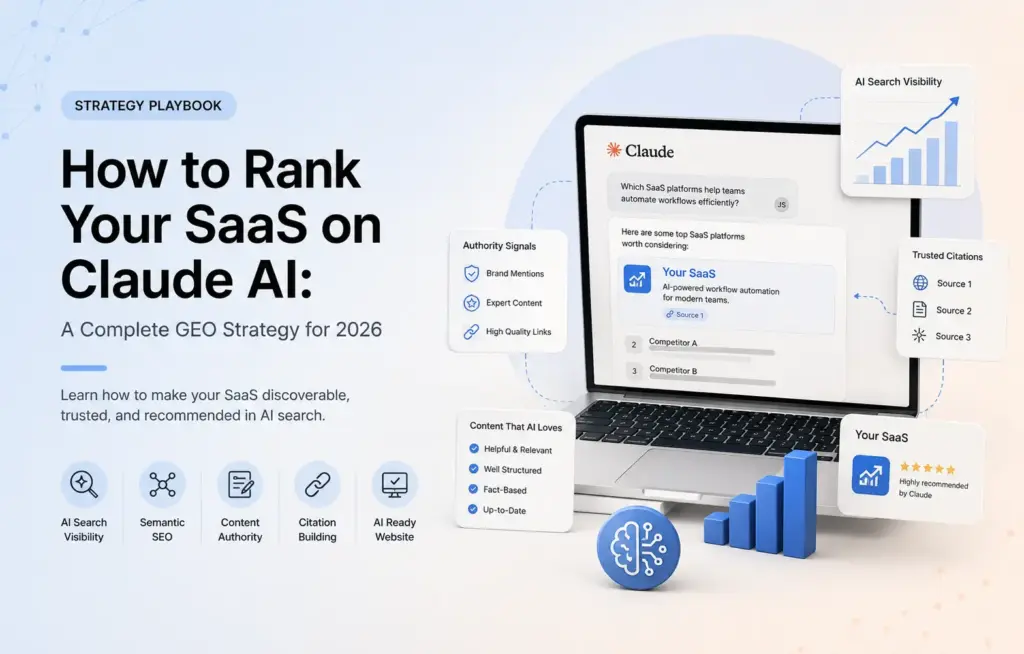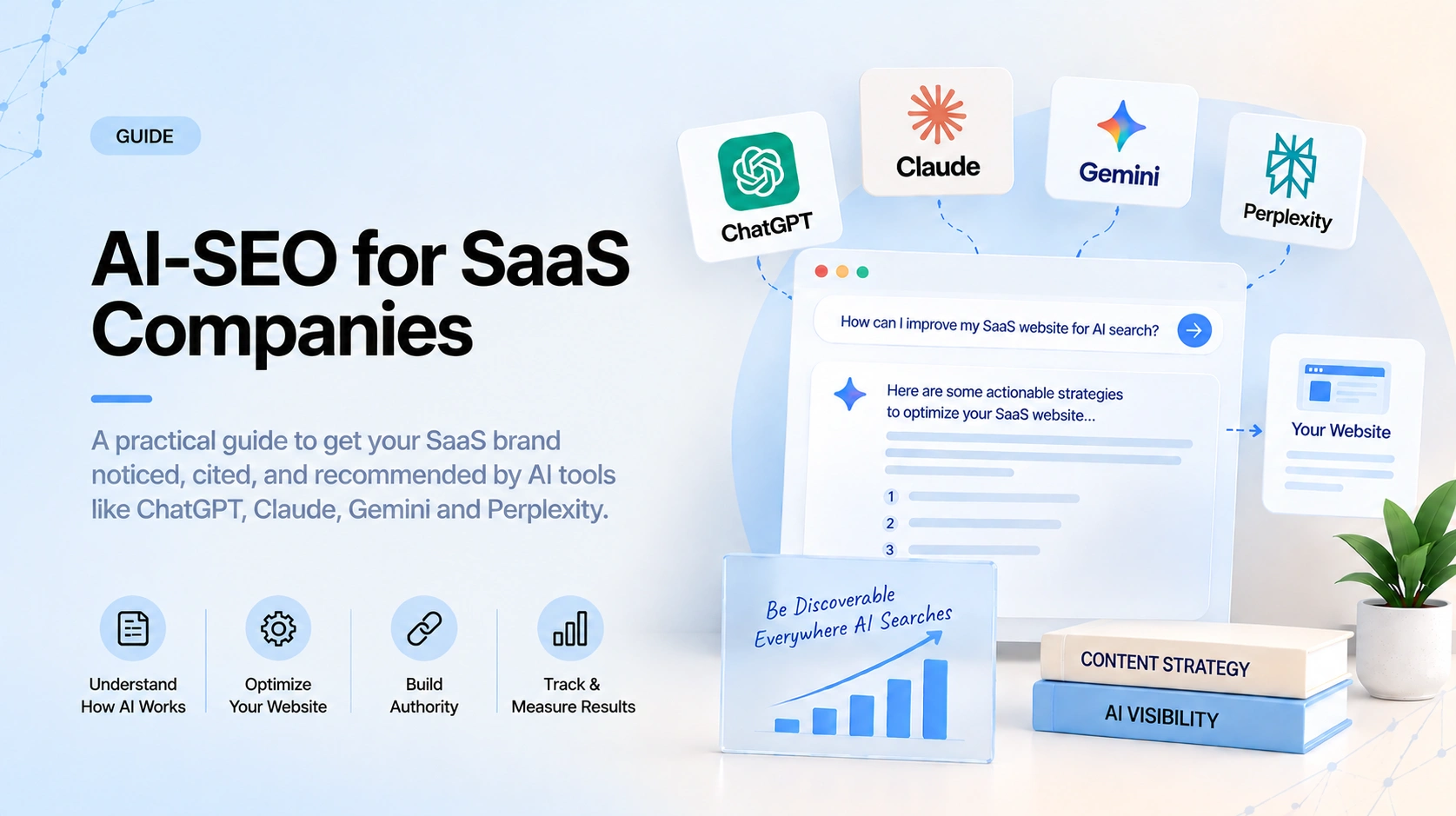
AI-SEO for a SaaS company is not a blog problem. ChatGPT, Claude, Gemini and Perplexity form their understanding of a SaaS product from the homepage, the pricing page, the documentation, the G2 profile, the case studies and the comparison pages a competitor wrote about you – not just the articles your content team publishes. Optimizing one page type while leaving the rest inconsistent or thin is why a product that ranks well on Google can still be invisible when someone asks an AI assistant to recommend a tool in its category.
This guide breaks down what each page on a SaaS website contributes to that understanding, what the current evidence says about which signals actually move AI citations, and where the evidence is still unsettled. Every claim below is labeled documented (the platform says so), observed (an independent study measured it), or inferred (a reasonable strategic conclusion without a confirmed rule) – because most of the AI-SEO content published in the last two years blurs that line, and the blur is where bad advice comes from.
The core distinction: ranking a page vs. teaching a system
Traditional SEO asks one question: how do I rank this page for this keyword? AI-SEO asks a different one: what does this page teach a system about who we are, what we sell, what problem we solve, and whether that claim can be verified elsewhere?
The mechanical difference matters. A ranking algorithm evaluates a URL against a query. A generative answer engine assembles a response from fragments pulled across many sources, and it does that assembly using entity recognition, not keyword matching – it needs to resolve “this company,” “this product,” “this feature,” and “this category” as stable concepts before it can decide whether your product is relevant to a question. A page can rank in Google and still fail at that second job if it never states, plainly, what category the company belongs to or what it does differently from the ten other tools in that category.
This is also why AI-SEO can’t be delegated to one content function. A content team can fix vague headlines. It cannot fix a pricing page that hides every number behind “Contact Sales,” an About page with no named experts, or a G2 profile that describes the product differently from the homepage. Those are product marketing, RevOps, and customer success decisions, and they carry as much AI-search weight as anything published on the blog.
Every SaaS page is an AI signal
Not every page teaches an AI system the same thing. A useful way to plan the work is to map each page type to the specific signal it’s responsible for, so gaps are visible instead of assumed to be covered by “the website” in general.
| Page type | Primary AI signal | What breaks if it’s missing |
| Homepage | Entity identity – who you are | The system can’t resolve the company as a stable entity across other mentions of it |
| Product page | Category and product identity | The product gets miscategorized or conflated with adjacent tools |
| Feature page | Capability-level understanding | Feature-specific buyer questions never surface the product |
| Pricing | Commercial context and buying maturity | The product looks unresolved on cost, a common disqualifier in “best for [budget]” answers |
| Use-case page | Problems solved, in the buyer’s language | Natural-language “how do I solve X” queries never connect to the product |
| Industry page | Who you serve | Vertical-specific queries default to a named competitor instead |
| Comparison page | Competitive and category context | The product is absent from the exact query type buyers ask most (X vs. Y) |
| Integration page | Ecosystem and workflow context | Platform-specific queries (“does it work with Salesforce”) go unanswered |
| Documentation | Product depth and technical credibility | Depth questions get answered from a competitor’s better-indexed docs |
| Case study | Evidence | Claims of outcomes have nothing to verify them against |
| Reviews / third-party profiles | Independent validation | The product fails what functions as a trust gate on most software-recommendation prompts |
| Listicles / press | External recommendation | The product never appears in the third-party sources these systems already lean on |
Improve any one row in isolation and the rest of the map still has holes. The sections below go through the page types that matter most for a SaaS company, in the order they tend to get built and neglected.
Homepage: resolving the entity
An AI system’s first job on any query about your company is entity resolution – deciding what kind of thing you are before it decides whether you’re relevant. A homepage that leads with a mission statement instead of a category definition makes that resolution harder, not more inspiring.
Compare these two openers:
“We empower businesses to unlock growth.”
“AI-powered revenue intelligence platform for B2B sales teams.”
The first tells a human reader nothing and tells a machine reader less. The second states a category (revenue intelligence platform), a differentiator (AI-powered), and an audience (B2B sales teams) in nine words – three separate entity facts a retrieval system can use immediately, without inference.
A homepage built for both audiences at once should make the following explicit, not implied:
- A one-sentence category definition, stated the way a buyer would search for it
- The primary problem solved, and for whom
- Core use cases, linked to their own pages rather than summarized only in a paragraph
- Proof points with numbers attached, not adjectives
- Customer logos, ideally tied to at least one quantified outcome nearby
- Integrations that matter to the buyer’s existing stack
- Links out to product, feature, and solution pages – the homepage should function as an index, not a dead end
Product and solution pages
A product page has to do a job the homepage can’t: establish exactly what’s being sold, to whom, and how it compares to the alternatives a buyer is already considering. That means naming the category explicitly (not just implying it through screenshots), stating the jobs-to-be-done the product covers, listing the integrations that matter, and linking forward to the feature pages and case studies that back up each claim.
Where product pages break down for AI-search purposes is scope creep: one page trying to cover an entire platform’s worth of functionality reads, to a retrieval system, as vague breadth rather than resolvable depth. A single “Platform” page describing twelve unrelated capabilities in one scroll gives a system nothing specific enough to match against a specific buyer question. The fix isn’t a longer page – it’s more pages, each doing less.
Feature pages: the most underbuilt asset on most SaaS sites
Feature pages deserve more attention than most SaaS marketing teams give them, because they’re the layer that maps directly onto how buyers phrase questions to an AI assistant. Nobody asks ChatGPT “tell me about this SaaS platform.” They ask “does this tool automate follow-up emails after a demo” – a capability-level question a generic “Features” page, listing forty capabilities in a grid with one line each, cannot answer with any precision.
One feature page should cover one clear concept:
- What the feature does, in plain language, before any screenshot
- The specific problem it solves and for whom
- How it actually works – enough mechanism to be credible, not a marketing paraphrase of “automatically”
- Concrete use cases and examples
- Integrations relevant to that specific feature
- Honest limitations – what the feature doesn’t do, which paradoxically increases trust in what it does claim
- Related features and related documentation, linked explicitly
- Customer evidence specific to that feature, where it exists
- An FAQ block addressing the two or three questions that feature actually generates in sales calls
A company with twelve real capabilities and twelve well-built feature pages gives an AI system twelve separate, resolvable answers. The same company with one “Features” page gives it one blurry one.
Pricing pages: a commercial-context signal, not just a conversion page
Pricing pages get treated as a bottom-of-funnel conversion mechanism and stop there. For AI-search purposes, a pricing page is also where a system resolves product packaging, customer segment, usage model, and buying maturity – information it needs to answer “what does [category] software cost” or “is [product] good for a team of 20” without guessing.
Hiding every number behind “Contact Sales” doesn’t protect a competitive advantage; it removes the one page that lets both a human and a machine compare the product on cost at all. A page with no visible tiers gives a retrieval system nothing to extract, so it either omits the product from cost-based comparisons entirely or, worse, repeats a stale number a reviewer estimated somewhere else.
A pricing page built for both audiences includes:
- Named tiers with what’s actually included in each, not just a price
- Explicit limits – seats, usage caps, storage, API calls
- The billing model and what “seat” or “usage unit” means in practice
- A feature comparison across tiers, in a table
- What “enterprise” or “custom” pricing typically covers, even without an exact number
- Free trial or freemium terms, stated plainly
- An FAQ section covering the objections that come up in every sales cycle anyway
None of this guarantees an AI system will recommend the product over a cheaper alternative. It does mean the product is resolvable on cost, which is the precondition for appearing in any cost-based comparison at all – a company Voxturr’s SaaS team has repeatedly seen get skipped entirely in “best tools under $X” answers not because it was too expensive, but because no system could determine what it cost.
Use-case and industry pages: connecting problem to product
Use-case pages exist to make one chain explicit: problem → use case → solution → product → feature → evidence. That chain is exactly the shape of a natural-language query someone types into an AI assistant (“how do I automate customer onboarding for a B2B SaaS product with a technical setup step”), which is why use-case pages tend to outperform generic feature lists on conversational queries.
Industry pages do the same job for a vertical, but only when they carry real substance: industry-specific terminology, workflows, regulatory context, integrations that vertical actually uses, and customer evidence from that vertical. A set of near-identical industry pages differing only in a swapped-out industry name in the H1 reads as thin to a human skimmer and as duplicate content to a retrieval system – building fewer, deeper industry pages beats building more, thinner ones.
Comparison and alternatives pages
“Your [Product] vs. [Your Competitor],” “alternatives to [Your Product],” and “best [Your category] software” are close to the exact phrasing buyers use when talking to an AI assistant during evaluation, which makes comparison content some of the highest-leverage TOFU-to-BOFU content a SaaS company can build. These pages also do something no other page type does as directly: they state explicit relationships between entities – this product, that competitor, this category – which is precisely the kind of structured relationship an AI system uses to answer comparative questions.
The failure mode here is bias so heavy it undermines its own usefulness: a comparison page that only lists a competitor’s weaknesses reads as marketing to a human and, increasingly, gets discounted as a low-trust source by systems weighing multiple comparison pages against each other. A comparison page that states real trade-offs – where a competitor genuinely wins, and for whom – is both more credible and more likely to be treated as a synthesizable source rather than skipped in favor of a more balanced third-party page.
Integration pages
Integration pages establish a specific relationship chain: product → platform → use case → workflow. A page titled “Salesforce Integration” that actually explains what syncs, in which direction, and what workflow it unlocks answers a specific buyer question directly. A page that’s just a logo and a sentence doesn’t. Given how often buyers evaluate tools by asking whether they connect to a system already in place, integration pages are worth building for every platform that meaningfully drives adoption, not just the handful with the biggest logos.
Documentation, knowledge base, and help center
Public documentation is one of the strongest technical-depth signals a SaaS company can offer, and one of the most consistently under-leveraged for AI-search purposes. Well-structured docs demonstrate exactly what a “Features” page can’t: real terminology, real workflows, real architecture, and real troubleshooting knowledge, all in the language practitioners actually use.
Two things determine whether documentation contributes to AI understanding at all: whether it’s crawlable and indexable (documentation locked behind a login wall or a JavaScript-only renderer that doesn’t serve readable HTML is invisible to most retrieval systems), and whether its information architecture makes individual pages resolvable as standalone answers rather than steps in a sequence that only make sense read in order. Making documentation public doesn’t mean private, sensitive material becomes part of any model’s training data – the practical question is narrower: can the public documentation a company already intends to be public actually be read by the systems evaluating the product.
Case studies and customer evidence
Case studies are where a SaaS company gets to replace adjectives with evidence, and the two read completely differently to both a human buyer and an AI system weighing a claim:
“Helped a leading company dramatically increase growth.”
“Reduced qualified lead acquisition cost by 34% over five months, moving from a manual outbound process to an automated sequencing workflow.”
The second version has a customer context, a starting point, an intervention, a number, and a timeframe – every element a retrieval system needs to treat the claim as a specific, checkable fact rather than marketing language it has to discount. A case study built around this skeleton (customer context → problem → baseline → intervention → measurable result → timeframe) does the evidentiary work a homepage’s proof-point section can only summarize.
Where an outcome can be tied to a specific engagement, name it. Voxturr’s own SaaS work – with companies including HighRadius, KredX, CashFlo, Zimyo, and Akenza – follows exactly this pattern: the evidence lives in the case study, not in an adjective on the homepage. A vague “helped many SaaS companies grow” claim is the weakest form this evidence can take; a specific engagement with a specific, dated result is the strongest.
Testimonials, reviews, and independent validation
There’s a meaningful difference between a first-party testimonial (a quote a company chose to publish about itself) and an independent review on a platform the company doesn’t control. Both have a place, but they answer different questions. A testimonial demonstrates that a company is willing to put its name behind a claim. An independent review demonstrates that someone with no incentive to flatter the product still chose to say something positive about it – and in an environment where AI systems increasingly need corroborating evidence before treating a company’s own claims as reliable, that second kind of validation carries more weight.
About, expert, and author pages
E-E-A-T gets treated as generic Google advice, but the underlying mechanism matters just as much for AI-search purposes: a page attributed to a named person with real credentials, a documented history of published work, and a verifiable professional identity is a different kind of source than an unattributed page with no author at all. This shows up at three levels – a real byline on every article, an About page that names actual people rather than describing “our team” abstractly, and (where it exists) published research, speaking, or original methodology tied to a specific person’s name. None of this replaces the content itself. It’s the layer that lets a system (and a skeptical human reader) treat a claim as coming from someone accountable for it.
Third-party profiles: G2, Capterra, and the review-platform ecosystem
This is the section most SaaS content strategies skip entirely, and the evidence says that’s a mistake – though the evidence is also more contested here than in almost any other part of this guide, so it’s worth reading the disagreement rather than a flattened summary of it.
Documented: In February 2026, G2 acquired Capterra, Software Advice, and GetApp from Gartner, consolidating most of the mainstream B2B software review category under a single company. G2’s own 2025 Buyer Behavior Report found GenAI chatbots had become the single largest influence on B2B vendor shortlists, at 17.1%, narrowly ahead of software review sites at 15.1%.
Observed, and conflicting: A 2026 citation study of ChatGPT’s software recommendations for high-intent “alternatives” searches found that every recommended tool had a Capterra presence and 99% had a G2 presence – but review score correlated weakly with placement, while Domain Rating correlated more strongly. Separately, a June 2026 study running 40 B2B SaaS categories through ChatGPT ten times each, producing 233 software recommendations, found G2 and Capterra received zero direct citations, with review aggregators as a category accounting for under 1% of all citations observed. A third dataset found domains with active G2, Capterra, and Trustpilot profiles saw roughly 3x higher ChatGPT citation rates than domains without them.
Those three findings aren’t actually contradictory once the mechanism is separated from the citation. The most defensible reading of the current evidence: G2 and Capterra function more as an eligibility gate than as a cited source. Almost every tool an AI system recommends has a review-platform presence, even in studies where the platform itself is rarely the link shown in the answer. Missing from G2 and Capterra entirely appears to correlate with not being recommended at all; having a strong presence there doesn’t guarantee being the cited link, but it appears to raise the odds of being in the recommendation set in the first place.
Inferred: treat review-platform presence as a floor to clear, not a ranking lever to maximize. Profile completeness, category accuracy, and consistent product description matter more than chasing review volume for its own sake – G2’s own published analysis found that a 10% increase in review count correlated with only about 2% more citations, explaining under 1% of the variance in outcomes. The organic-traffic collapse across every major review platform – G2 down roughly 84.5%, Capterra down 89%, Software Advice down 86.5%, and TrustRadius down 92.2% between January 2024 and December 2025 – is itself informative: buyers are reading these platforms through an AI intermediary now, not by visiting them directly, which is exactly why what those profiles say matters more than how much traffic they draw on their own.
What actually moves the needle on a G2 or Capterra profile:
- A category listing that matches the company’s own website description exactly – inconsistency between “how we describe ourselves” and “how G2 categorizes us” creates ambiguity a system has no clean way to resolve
- Complete product information: features, integrations, screenshots, pricing consistent with the pricing page
- Review text, not just review score – the specific language reviewers use is what a model draws on when describing the product, more than an aggregate star rating
- Freshness – dated, recent reviews outweigh a large volume of old ones
- Consistency across G2, Capterra, LinkedIn, and the company’s own site – three different descriptions of the same product create the exact ambiguity this entire guide is arguing against
The “best [category] software 2026” listicle ecosystem
Independent listicles function as external category and recommendation signals: a “best CRM software” article isn’t neutral in an AI system’s eyes, but it also isn’t invisible – it’s one more data point in a synthesis process. The relationship runs: AI query → web sources → third-party pages → SaaS entities/products → recommendation context.
This is not the same as “get listed on twenty blogs and ChatGPT will recommend you.” A single mediocre listicle mention changes very little. What appears to matter is the aggregate web footprint: how consistently a product is described, positioned, and recommended across independent sources with genuine editorial standing – publication authority, methodology transparency, list freshness, and author credibility all factor into whether a given listicle functions as a real signal or as noise a system down-weights.
Mass guest-posting and paid, low-quality listicle placements are the predictable overcorrection here, and they’re counterproductive for the same reason keyword-stuffed pages are: volume without editorial credibility reads as noise to both a human evaluator and a synthesis system weighing source quality, and it risks flagging a brand’s broader footprint as manufactured rather than earned.
ChatGPT vs. Claude vs. Gemini vs. Perplexity: what’s actually different
Treating “AI search” as one undifferentiated target is the single most common strategic error in this space. The four major systems retrieve, weight, and cite sources differently enough that optimizing for one doesn’t transfer cleanly to the others.
| Dimension | ChatGPT | Claude | Gemini | Perplexity |
| Retrieval basis | Live web search plus parametric (trained-in) knowledge | Live web search plus parametric knowledge | Google Search-grounded, via query fan-out into sub-queries | Retrieval-first; sources are central to generation, not an add-on |
| Overlap with Google’s top-10 organic results | ~0% median domain overlap in one 11,500-query study | Not separately measured in the same study | ~8.5% median overlap in the same study | ~14.3% median overlap in the same study |
| Content freshness bias | Favors very recent content (~56% of journalism citations from the last 12 months, per Muck Rack data) | Longest freshness window observed; ~3x more likely than ChatGPT to cite 2–4 week old content, only ~36% from the last 12 months | Inherits Google’s own freshness weighting | Favors “this month” recency, between ChatGPT and Claude |
| Citation-source overlap with each other | Only ~11% of cited domains overlap between ChatGPT and Perplexity, across a 680-million-citation analysis | Highest owned-brand citation share among engines tested in one six-brand study (9.1%) | Own citation logic; ~13.7% URL overlap with Google’s own AI Overviews despite similar conclusions | Lowest owned-brand citation share among engines tested in the same study (6.8%, vs. Claude’s 9.1%) |
Documented: Gemini’s grounding mechanism is Google’s own query fan-out – a single query is rewritten into multiple sub-queries, each run through Google Search independently, with citations pulled across the combined results. This is why an Ahrefs analysis of 863,000 SERPs found only 38% of AI Overview citations came from the query’s own top-10 organic results, down from 76% roughly a year earlier – the citations increasingly come from the fan-out, not the original query’s ranking.
Observed: Independent studies converge on a low cross-platform overlap finding even when they disagree on the exact number – 11% (a 680-million-citation analysis), 12% (an Ahrefs query-level comparison against Google’s own top 10), and 35–40% of queries returning zero shared cited domains across ChatGPT, Perplexity, and Gemini in another analysis. The consistent conclusion across differently-designed studies: a brand strategy built around one AI engine’s citation behavior structurally misses most of the others.
Inferred: the practical implication is not “pick a favorite engine.” It’s that the underlying website strategy – clear entity signals, consistent product description, reviewable evidence, independent validation – has to be platform-agnostic, because no single optimization tactic transfers reliably across engines with this little source overlap. Chasing one engine’s specific behavior is a weaker long-term bet than strengthening the entire signal set this guide covers.
AI-readiness and visibility tools: what they’re actually for
Tools identify gaps. They don’t replace the content, evidence, and expertise this guide is about – a high “AI readiness” score with a thin, generic website underneath it doesn’t produce citations.
Site accessibility and crawlability: Cloudflare’s free scanner, isitagentready.com, checks a site across discoverability, content accessibility, bot access control, protocol discovery, and commerce readiness, and returns remediation steps a developer can act on directly. Cloudflare’s separate Content Signals extension to robots.txt lets a site declare, per-crawler-category, whether content may be used for search indexing, live AI answers, or model training – three separate decisions, not one blanket allow/deny.
AI citation and visibility tracking: a maturing category of tools (Profound, the Semrush AI Visibility Toolkit, Ahrefs Brand Radar, Peec AI, Otterly.AI, Rankscale, AthenaHQ, among others) monitor how often and how favorably a brand is mentioned across ChatGPT, Perplexity, Gemini, and Google AI Overviews. These tools differ meaningfully in how they collect data – a licensed panel of real prompts, a clickstream database, or a scraped chat interface are not equivalent measurements, which is why two trackers can report different numbers for the same brand in the same week. Treat their output as a monitoring layer over the work in this guide, not a substitute for it.
One caution worth stating plainly, because the evidence is unusually clean on this point: llms.txt, the proposed root-level file summarizing a site for AI systems, does not currently move AI citation frequency. An SE Ranking analysis of roughly 300,000 domains found no measurable relationship between having the file and citation frequency. A separate Ahrefs analysis of 137,210 domains found adoption at around 28%, but only about 3% of those files received any crawler requests at all during the study period. Google has stated on the record that no Google Search system reads or acts on it; OpenAI, Anthropic, and Perplexity have not publicly committed to using it either. Publishing one costs little and isn’t harmful, but it should be treated as low-cost future insurance, not a visibility strategy.
Keyword and question research: what the tools are actually for
Ahrefs, Semrush, Google Search Console, AnswerThePublic, Google Trends, AlsoAsked, Reddit search, and a company’s own sales-call and support-ticket questions all do the same underlying job differently: surfacing the informational, comparison, and problem-based questions buyers are actually asking, in their own language, before they’ve named a product.
The goal isn’t “find keyword → publish 1,500 words → rank.” It’s question discovery feeding an entity and relationship map: which concepts, categories, problems, and terms does this company need to connect to a coherent answer, and which of its pages currently do that job. A keyword tool tells you the question exists. It doesn’t tell you whether the answer is currently resolvable anywhere on the site – that’s the audit this guide builds toward below.
Reframing “What is X?” content for 2026
Generic definitional content is being commoditized by the same systems it’s trying to reach – an AI assistant can already produce a competent, generic answer to “what is a CRM,” which means a page that only repeats that answer adds nothing a system needs from an external source. The opportunity in TOFU content isn’t answering the basic question; it’s answering the version of the question the basic answer doesn’t cover.
Instead of:
“What is a CRM?”
A stronger 2026 framing:
“What Is a CRM in 2026? How AI Has Changed What CRM Software Actually Does”
covering the traditional definition briefly, then the actual substance: AI-assisted data capture, predictive scoring, conversational interfaces, agentic workflows, and – critically – what a buyer should now evaluate that a 2023-era buying guide wouldn’t have mentioned. The formula generalizes:
[Educational query] + [2026 evolution] + [AI/search/business context]
- What is SaaS SEO in the age of AI search?
- What is a knowledge base, and why does it matter for AI search specifically?
- What is product-led growth in an AI-first SaaS market?
- What is an AI agent, and how is it different from a chatbot or a workflow automation tool?
- How do AI search engines decide which SaaS products to recommend?
This works because educational content, done this way, isn’t really competing to “rank.” It’s establishing the relationships – between entities, categories, problems, and terminology – that an AI system draws on when a completely different, more specific question comes in later.
Original data and published methodology
Original research is a stronger authority asset than opinion content, because it’s the one thing a competitor genuinely cannot republish. The shape that matters: data source → sample → methodology → analysis → findings → limitations, published transparently enough that a skeptical reader (or an AI system weighing it against a competing claim) can evaluate it rather than just trust it.
This is also where an agency’s own positioning has to hold up under the same scrutiny it’s asking of everyone else. Voxturr’s approach is built around exactly this pattern – proprietary data from 750+ webinars and 500+ events delivered across 150+ client engagements, rather than repackaged third-party research – because that dataset is the one part of this entire discipline that can’t be commoditized by an AI system summarizing publicly available sources. When we analyze SaaS company websites for AI-readiness, the recurring pattern isn’t thin content – most SaaS sites publish plenty of words. It’s inconsistency: a category described one way on the homepage, another way on G2, and a third way in a case study, which is precisely the kind of ambiguity that keeps a company out of a confident AI answer even when every individual page is well-written.
The signal stack: a framework for prioritizing the work
Nine layers, roughly in the order an AI system needs them resolved to answer a question about a company with any confidence:
| Layer | Question it answers | Where it lives |
| 1. Entity | Who are you? | Homepage, About page, Wikipedia/Wikidata where applicable |
| 2. Product | What do you sell? | Product and solution pages |
| 3. Capability | What can it do? | Feature pages |
| 4. Context | Who is it for, and what problem does it solve? | Use-case and industry pages |
| 5. Evidence | What proves it? | Case studies, quantified proof points |
| 6. Authority | Who says you’re credible? | Reviews, testimonials, named experts |
| 7. Distribution | Where else is this represented? | G2, Capterra, listicles, press, community |
| 8. Freshness | Is the information current? | Update cadence across every layer above |
| 9. Originality | What do you know that others don’t? | Original research, proprietary data, named frameworks |
A company can be strong on Layers 1–4 (a well-built site) and still be invisible on Layers 6–7 (no independent validation) – which is exactly the gap the G2/Capterra section above describes, and exactly why “just improve the website” undersells what this actually requires.
90-day implementation roadmap
This is a sequencing framework, not a guaranteed ranking formula – no credible AI-search strategy can promise a specific citation outcome on a specific timeline.
Days 1–30 – Foundation Fix entity clarity on the homepage. Audit and rebuild product and feature pages that currently try to cover too much ground in one page. Make pricing transparent, or at least resolvable. Confirm technical accessibility – crawlable documentation, no login walls on public content, a clean robots.txt with explicit Content Signals. Claim and complete G2 and Capterra profiles, matching category and description exactly to the website.
Days 31–60 – Authority Publish the TOFU and educational content that connects concepts, categories, and problems – using the reframed “What is X in 2026” approach above, not generic definitions. Build or deepen use-case, industry, and comparison pages. Ship the case studies that currently exist only as unpublished sales collateral. Fix internal linking so pages reference each other in context, not through a static “related topics” block.
Days 61–90 – External authority Pursue original research if none exists yet. Pitch genuinely relevant listicle inclusion – not mass guest posting. Pursue analyst and press mentions where the company has real news. Track citation and visibility metrics across engines to see which layers of the stack are and aren’t resolving.
SaaS AI-SEO audit checklist
Score each item 0 (absent), 1 (partial), or 2 (complete and current).
Website Homepage entity clarity · dedicated product pages · dedicated feature pages (one concept each) · transparent pricing · use-case pages · industry pages with real depth · comparison/alternatives pages · integration pages · public, crawlable documentation · published case studies · named authors/experts · contextual internal linking · relevant schema in place
Content Educational coverage reframed for 2026 · TOFU questions mapped to real search/prompt behavior · category and terminology consistency · original research or data · published methodology · visible “last updated” dates
External ecosystem G2 profile complete and current · Capterra profile complete and current · other relevant review platforms · genuine listicle inclusion · independent reviews · press or analyst mentions · community presence (Reddit, relevant forums)
Technical Crawlability and indexability · canonicalization · page performance · server-rendered (not JS-only) content where AI crawlers need it · robots.txt with explicit Content Signals · documentation accessible without a login wall
A company scoring high on Website and low on External Ecosystem has a resolvable product with no independent validation – the most common gap this guide has described. A company scoring high on External Ecosystem and low on Website has third-party proof pointing at a source that can’t answer the follow-up question.
What not to do
- Publishing generic AI-written blog content at volume, with no original insight underneath it
- Stuffing “AI SEO” or “GEO” keywords into copy that doesn’t need them – this measurably reduces extractability rather than improving it
- Building hundreds of near-duplicate programmatic pages to cover every keyword variant
- Publishing “What is X?” content with no 2026-specific angle, competing directly with what an AI system can already generate unassisted
- Hiding pricing, packaging, or product scope behind “Contact Sales” entirely
- Letting category or product descriptions drift out of sync across the website, G2, Capterra, and LinkedIn
- Fabricating testimonials or case-study outcomes
- Mass guest-posting or buying placement in low-quality listicles
- Buying backlinks with no editorial relevance
- Asserting specific algorithmic behavior (“ChatGPT ranks by X,” “Gemini prefers Y”) without a documented or independently observed basis
- Treating llms.txt as a ranking lever rather than the low-cost, unproven convention the current evidence shows it to be
- Assuming structured data guarantees a citation, or that being indexed is the same as being recommended
FAQ
Does having a G2 profile actually help with AI search? It functions more as an eligibility gate than a guaranteed citation source. Studies disagree sharply on how often G2 or Capterra are the cited link in an AI answer, but converge on a related point: almost every product an AI system recommends has a complete profile on at least one major review platform, and companies with active, consistent profiles see meaningfully higher citation rates than companies with none.
How should a SaaS company create TOFU content for ChatGPT and Perplexity specifically? Build for the underlying mechanism, not one platform: map the real questions buyers ask (via keyword tools, support tickets, and sales calls), reframe generic definitional queries around what’s genuinely changed by 2026, and make sure each answer can stand alone as a self-contained response – because the platforms retrieve and weight sources too differently to optimize for one at the expense of the others.
What pages should a SaaS website have for AI-search visibility? At minimum: a clearly positioned homepage, dedicated product and feature pages (not one page trying to cover everything), a transparent pricing page, use-case and industry pages with real depth, honest comparison content, integration pages for the platforms that matter, public and crawlable documentation, published case studies, and complete, consistent third-party profiles on G2 and Capterra.
Is llms.txt worth implementing? It’s low-cost and not harmful, but current evidence shows no measurable relationship between having the file and AI citation frequency, and no major AI platform has confirmed using it in production. Treat it as optional future-proofing, not a visibility strategy.
Final takeaway
The mistake this entire guide is trying to correct is treating AI-SEO as a technique to bolt onto an existing content plan. It isn’t. It’s a different question about the same website: not “how do I rank this page,” but “can a system that has never talked to a human at this company still resolve who we are, what we sell, who it’s for, and why the claims should be trusted.” Every page type covered here is answering a piece of that question. A company that gets the pricing page, the G2 profile, and the case studies right, and neglects the rest, is still only partially resolvable – and partially resolvable is functionally invisible the moment a system needs a confident answer.