

D2C Growth Marketing
I regularly meet D2C founders who describe the same problem without recognising it as the same problem. Revenue grows in bursts when they run paid campaigns and stalls when they stop. Customer numbers increase but profit does not follow. Every month feels like starting over. This is not a D2C growth marketing problem in the abstract. It is a specific structural failure: spending almost entirely on acquisition while neglecting the retention and referral systems that make acquisition economics sustainable.
However, the instinct is always to run more ads. Scale the paid budget. Try a new channel. Hire another performance marketer. None of these address the underlying problem, which is that a D2C business that acquires customers and then loses them to one-time purchase behaviour is a leaky bucket. More water in does not fix the leak.
True D2C growth marketing is a system, not a channel. It connects acquisition, activation, retention, referral, and revenue into a compounding engine where each part makes the others more efficient. This guide explains what that system looks like and how to build it.
What Growth Marketing for D2C Brands Actually Means
Growth marketing is not a synonym for performance marketing. Growth marketing for D2C brands is the discipline of designing, running, and optimising the full system that takes a potential customer from first awareness to loyal repeat buyer. Performance marketing is one input into that system. It is not the system itself.
Specifically, D2C growth marketing covers five interconnected activities. Customer acquisition: getting new buyers to discover and purchase for the first time. Activation: ensuring the first purchase experience delivers sufficient value to create a second purchase intent. Retention: building the habits, incentives, and relationships that bring customers back consistently. Referral: turning satisfied customers into a source of new customer acquisition. Revenue expansion: increasing the average order value and lifetime value of the existing customer base. Each of these activities requires different skills, different channels, and different measurement frameworks. Most D2C brands invest heavily in the first and neglect the other four.
The Difference Between Growth Marketing and Performance Marketing
Performance marketing is optimising paid channels for immediate conversion metrics. Cost per click, cost per acquisition, ROAS. It is essential and it is measurable. It is also one layer of a much larger system.
Growth marketing includes performance marketing but also includes product optimisation for retention, referral programme design, email and CRM strategy, conversion rate optimisation, pricing and bundling experiments, and the data infrastructure that connects all of these into a coherent picture of what is driving growth and what is not. Furthermore, the time horizon for growth marketing is longer. Performance marketing is optimised day to day. Growth marketing is built to compound over quarters.
The D2C Growth Strategy Funnel: From Discovery to Loyalty
Solutions Designed for Every Stage of SaaS Growth
Our hands-on marketing execution services turn strategy into action, ensuring your SaaS growth engine grows across every stage of the customer journey: awareness, acquisition, activation, and retention.
A D2C growth strategy is built around five funnel stages. Understanding what breaks at each stage is more valuable than investing uniformly across all of them. Most D2C brands have a specific stage where the funnel leaks most severely. Finding and fixing that stage produces the highest return on growth investment.
| Funnel Stage | Primary Question | Key Channels | Success Metric | Common Failure |
| Discovery | Can potential buyers find us? | Paid social, SEO, influencer, PR | New visitor growth rate | Spending on acquisition before product-market fit |
| Consideration | Do visitors understand our value? | Website, content, email, retargeting | Add-to-cart rate | Homepage traffic without dedicated landing pages |
| Conversion | Do visitors become buyers? | Website UX, offers, trust signals | Checkout completion rate | Checkout friction and missing social proof |
| Retention | Do buyers come back? | Email, WhatsApp, push, community | Repeat purchase rate | No post-purchase engagement system |
| Advocacy | Do buyers bring other buyers? | Referral programme, UGC, reviews | Referral rate and review count | No structured mechanism for generating referrals |
The diagnostic question I ask every D2C founder is: at which stage are you losing the most potential revenue? A brand with strong awareness but poor conversion has a website and offer problem. A brand with strong first-purchase conversion but low repeat rate has a retention problem. A brand with strong retention but slow top-of-funnel growth has an acquisition scaling problem. The answer determines where D2C growth marketing investment should be concentrated.
D2C Customer Acquisition: Building a Multi-Channel System
Sustainable D2C customer acquisition does not depend on a single channel. Brands that rely exclusively on Meta ads for new customer acquisition are exposed to platform changes, rising CPMs, and auction dynamics outside their control. The D2C brands that grow most consistently build acquisition across at least three complementary channels.
Paid Social: The Fastest Acquisition Channel
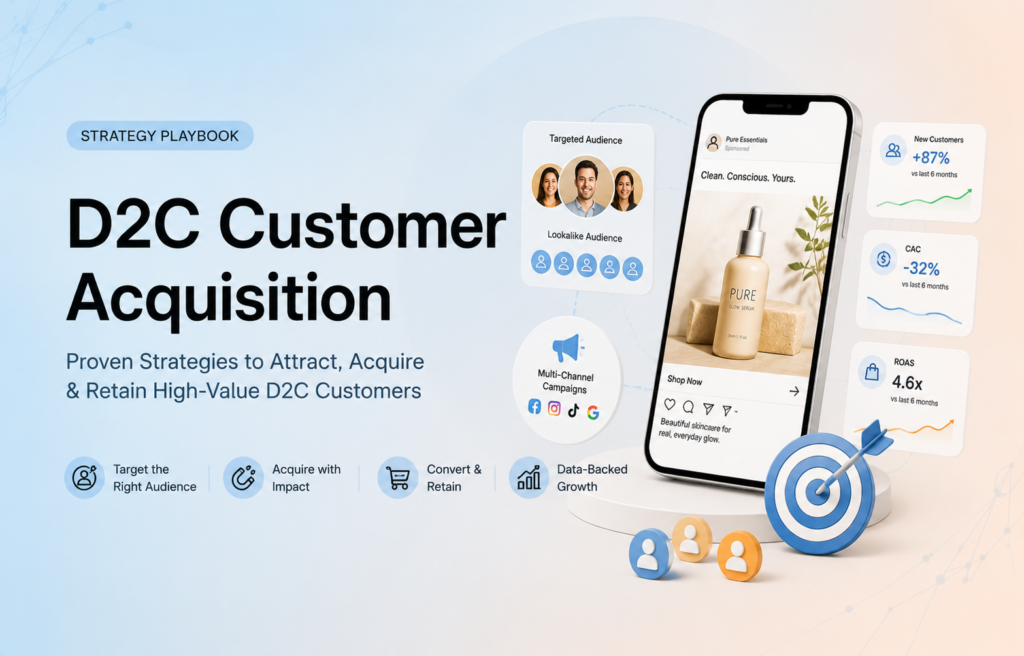
Paid social on Instagram and Facebook remains the highest-volume customer acquisition channel for most Indian D2C brands. The targeting precision, the visual format alignment with product categories, and the sheer size of the addressable audience make it the natural starting point for scaling acquisition.
The challenge with paid social acquisition in 2026 is that CPMs have risen significantly as more D2C brands compete for the same audiences. The brands winning on paid social are those with superior creative, precise audience targeting built on high-LTV customer lookalikes, and a post-click experience that converts efficiently. D2C performance marketing on paid social is no longer a media buying exercise. It is a creative and conversion system.
Organic and Content-Led Acquisition
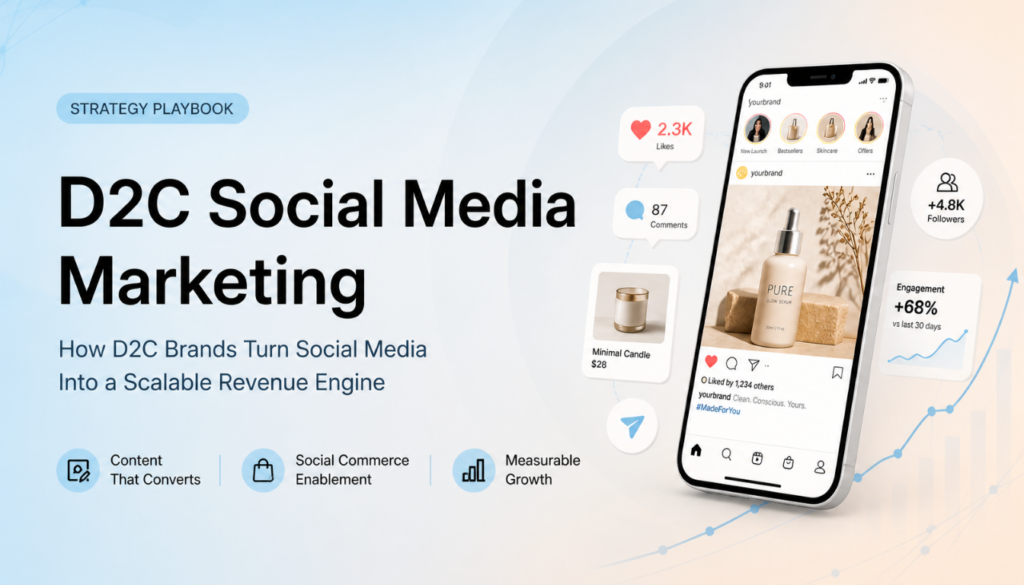
Organic acquisition through D2C social media marketing and content builds lower-CAC customer cohorts than paid channels because the trust is earned rather than purchased. An Instagram Reel that reaches 200,000 people organically and converts 150 of them into customers has produced those customers at near-zero acquisition cost. This compounds. The customers acquired through organic channels tend to have higher lifetime value and stronger referral behaviour than paid acquisition cohorts because they discovered the brand through genuine interest rather than advertising interruption.
Influencer-Led Acquisition
Influencer-led acquisition occupies a unique position in the D2C growth marketing channel mix. It combines the scale of paid media with the trust of organic discovery. A micro influencer recommending your product to 25,000 highly specific followers is delivering both reach and credibility simultaneously. For D2C influencer marketing to function as a genuine acquisition channel rather than a brand awareness activity, it requires precise creator selection, conversion-oriented briefs, and discount code-based attribution to measure actual sales generated per creator.
Referral and Community-Led Acquisition
Referral acquisition is the most capital-efficient customer acquisition channel available to D2C brands because the acquisition cost is largely borne by your existing customers. A referral programme that gives existing customers a meaningful reward for introducing a friend creates a self-sustaining acquisition loop. The referred customer arrives pre-qualified, pre-trusted, and with a higher first-order conversion rate than any paid channel can produce. Building a referral programme into your D2C growth strategy from early in the brand’s life produces compounding returns that become more valuable as the customer base grows.
D2C Retention Marketing: Where Most Brands Leave the Most Money
Retention is the most underleveraged lever in D2C growth marketing. Most brands invest ten times more in acquiring new customers than in retaining existing ones, despite the fact that acquiring a new customer costs five to seven times more than selling to an existing one. The brands that have figured out retention are the ones that can afford to acquire aggressively because they are not losing the customers they paid to acquire.
The Repeat Purchase Rate Benchmark
The repeat purchase rate is the single most important retention metric for a D2C brand. It measures what percentage of first-time buyers make a second purchase within a defined window, typically 90 or 180 days. For most D2C categories, a healthy repeat purchase rate sits between 25 and 40 percent within 90 days. Below 15 percent indicates a serious retention problem. Above 40 percent indicates a brand that has built genuine customer loyalty.
Improving repeat purchase rate by even 5 percentage points has a dramatic effect on unit economics. If your average CAC is 400 rupees and your average order value is 800 rupees, a customer who purchases once gives you 400 rupees in gross margin minus 400 rupees CAC, which is zero contribution. A customer who purchases three times gives you 1,200 rupees in gross margin minus 400 rupees CAC, which is 800 rupees contribution. Retention is where D2C brand growth actually happens at the unit economics level.
Email and WhatsApp: The Retention Infrastructure
Email and WhatsApp are the two highest-return retention channels for D2C brands because they are owned channels with near-zero marginal cost. A well-structured post-purchase email sequence costs the same to send to 1,000 customers as to 100, but produces proportionally more retained revenue as the customer base grows.
The post-purchase email sequence that produces the best retention results covers five moments. A welcome email immediately after the first purchase that sets expectations and introduces the brand story. A usage guide email two to three days after delivery that helps the customer get maximum value from the product. A check-in email one week after delivery that solicits feedback and addresses any concerns. A replenishment reminder email timed to the product’s consumption cycle. And a loyalty milestone email that rewards customers who have purchased multiple times.
Subscription and Replenishment Models
For D2C brands selling consumable products, subscription and auto-replenishment models are the most powerful retention mechanism available. A customer who subscribes to monthly delivery of your product has a lifetime value that is three to five times higher than a one-time buyer, and their acquisition cost is identical. Building a subscription option into your D2C retention marketing programme is the single highest-impact structural decision a consumable D2C brand can make.
The subscription models that retain customers long-term offer genuine flexibility. Pause, skip, and cancel options that are easy to use reduce churn more than pricing incentives alone, because customers who feel trapped cancel and feel negative about the brand, while customers who feel in control stay subscribed and feel positive. The data consistently shows that subscription programmes with easy pause and skip options have lower churn rates than those with restrictive terms.
The D2C Growth Stack: Tools and Data Infrastructure
A D2C growth marketing system requires a minimum viable technology stack to function. Brands that try to run growth programmes on spreadsheets and intuition are making decisions based on incomplete information. The right tools do not need to be expensive. They need to be connected.
The Minimum Viable D2C Growth Stack
| Function | Tools | What It Enables | Priority |
| Ecommerce platform | Shopify, WooCommerce | Product catalogue, checkout, order management | Essential |
| Email and CRM | Klaviyo, Mailchimp, HubSpot | Automated post-purchase flows, segmentation | Essential |
| Analytics | Google Analytics 4, Mixpanel | Traffic sources, funnel analysis, cohorts | Essential |
| Customer data | Segment, RudderStack | Unified customer profile across touchpoints | High |
| Paid social | Meta Ads, Google Ads | Paid acquisition at scale | Essential |
| WhatsApp marketing | Interakt, Wati, Gupshup | Retention, reorder triggers, customer support | High |
| Review and UGC | Yotpo, Judge.me, Okendo | Social proof generation and display | High |
| A/B testing | Google Optimize, VWO, Optimizely | Conversion rate optimisation on site | Medium |
| Referral programme | ReferralCandy, Extole | Structured referral acquisition | Medium |
The tools matter less than how they are connected. A D2C brand using five disconnected tools that do not share data is making decisions about acquisition in isolation from retention data, making decisions about email in isolation from purchase history, and making decisions about paid spend in isolation from customer lifetime value. The growth stack that produces the best decisions is the one where customer behaviour at every touchpoint flows into a single place where it can be analysed together.
Growth Experiments Every D2C Brand Should Be Running
The brands that compound growth fastest are the ones that run the most structured experiments. Not random tests but a disciplined programme of hypothesis-driven experiments across conversion, pricing, product, and referral. D2C growth strategy built on continuous experimentation consistently outperforms strategy built on assumptions.
Conversion Rate Optimisation Experiments
Most D2C websites convert between one and three percent of visitors. Moving this by even 0.5 percentage points has the same effect as a 20 to 50 percent increase in paid traffic, at zero additional acquisition cost. The experiments with the highest return for most D2C brands are: removing navigation from the checkout page to reduce exit points, adding social proof (review counts, customer photos) above the fold on product pages, testing urgency signals (low stock indicators, time-limited offers) on product and cart pages, and simplifying the checkout to the minimum required fields.
Run these as structured A/B tests with a defined hypothesis, a minimum sample size, and a statistical significance threshold before declaring a winner. The most common experimentation mistake is calling a test early because one variant looks better after three days of data. Most conversion rate experiments need two to four weeks of data to produce reliable results.
Pricing and Bundling Experiments
Pricing and bundling are the highest-leverage revenue per order experiments available to D2C brands. A bundle that combines a hero product with a complementary product at a slight discount increases average order value significantly without increasing acquisition cost. The data from D2C performance marketing experiments consistently shows that bundles with clear value framing (“save 20 percent versus buying separately”) outperform individually priced products for first-time buyers in categories where the complementary use case is obvious.
Test three pricing and packaging configurations simultaneously: single unit, a starter bundle, and a subscription option. The distribution of first purchases across these three options tells you exactly how price-sensitive your acquisition audience is and how willing they are to commit to repeat purchase at the first purchase moment.
Referral Programme Experiments
A referral programme that is not generating at least 10 to 15 percent of new customers is either structured incorrectly or not being promoted adequately. The experiments that most improve referral programme performance are: testing the reward structure (both parties rewarded vs only the referrer vs only the referred), the timing of the referral ask (immediately post-purchase vs seven days after delivery vs after a positive review), and the framing of the referral ask (“give a friend 15 percent off” outperforms “earn 15 percent off for each referral” consistently).
Unit Economics: The Numbers That Determine Whether D2C Brand Growth Is Sustainable
Growth without sustainable unit economics is a liability, not an asset. D2C brand growth that depends on acquiring customers at a loss and hoping to make it up in volume is a business model problem, not a marketing problem. Understanding the numbers that determine D2C viability is a prerequisite for intelligent growth marketing investment.
The Three Numbers Every D2C Founder Must Know
Customer Acquisition Cost (CAC) is the total amount spent on marketing and sales divided by the number of new customers acquired in the same period. Include all marketing costs: paid media, influencer fees, content production, agency fees. A CAC that is calculated only from paid ad spend is meaningless because it excludes the full cost of building the customer relationship.
Customer Lifetime Value (LTV) is the total revenue a customer generates across all of their purchases, minus the cost of goods sold. This is the number that determines whether your CAC is justified. An LTV of 2,000 rupees with a CAC of 400 rupees is a healthy business. An LTV of 600 rupees with a CAC of 400 rupees is a business in trouble regardless of revenue growth.
CAC Payback Period is how long it takes to recover the CAC from a customer’s gross margin contribution. For most D2C brands, a payback period under six months is healthy. Above twelve months creates significant cash flow pressure because you are financing customer acquisition for a year before the relationship becomes profitable.
| Metric | Healthy Range | Warning Zone | How to Improve |
| LTV:CAC Ratio | Above 3:1 | Below 2:1 | Improve retention OR reduce CAC through organic channels |
| CAC Payback Period | Under 6 months | Above 12 months | Increase AOV through bundles OR improve repeat purchase rate |
| Repeat Purchase Rate | 25 to 40% at 90 days | Below 15% at 90 days | Build post-purchase email flows and subscription options |
| First-Order Margin | Above 40% | Below 25% | Review COGS, shipping, and packaging costs |
| Blended ROAS | Above 3x | Below 2x | Improve creative, landing pages, and organic channel mix |
| Refund Rate | Under 3% | Above 7% | Product quality review and expectation management in marketing |
D2C Growth Marketing in India: The Market Dynamics That Change the Calculus
The Indian D2C market has specific characteristics that global growth marketing frameworks do not account for. Any D2C growth marketing system built for India needs to be designed around these realities, not adapted from frameworks built for US or European markets.
Tier 2 and Tier 3 Cities Are Now the Growth Frontier
The first wave of Indian D2C growth was predominantly metro-driven. Mumbai, Delhi, Bengaluru, and Hyderabad provided the initial customer base for most Indian D2C brands. That market has matured. The next significant growth opportunity sits in Tier 2 and Tier 3 cities where internet penetration is rising rapidly, disposable income is growing, and D2C brand penetration is still low.
Capturing Tier 2 and Tier 3 growth requires specific adaptation. Vernacular content in the regional language of the target geography. Cash on delivery as a payment option because digital payment adoption is lower. Logistics partners with strong regional coverage. And pricing calibrated to the average disposable income in the target geography rather than the metro average. Brands that apply their metro D2C growth strategy unchanged to Tier 2 expansion consistently underperform brands that adapt meaningfully.
COD Economics Require a Specific Approach
Cash on delivery represents 40 to 60 percent of D2C orders in India depending on category and geography. COD orders have higher return and cancellation rates than prepaid orders because the purchase commitment is lower. A customer who pays upfront has made a financial decision and is invested in the purchase. A customer who chose COD has not parted with any money yet.
Managing COD economics in D2C performance marketing requires: a COD confirmation call or WhatsApp message immediately after the order to confirm delivery intent and reduce cancellation rate, targeted paid campaigns designed to encourage prepaid conversion with a small incentive (five to ten percent discount for choosing UPI or card), and COD-to-prepaid conversion rate tracking as a key operational metric. Brands that actively manage their COD-to-prepaid conversion ratio consistently operate at better unit economics than those that accept COD as a fixed cost.
Trust Is the Primary D2C Growth Lever in India
Indian consumers in all markets but particularly outside metros have a higher trust threshold for purchasing from unfamiliar D2C brands than consumers in more established e-commerce markets. The question underlying every Indian D2C purchase decision is: is this brand legitimate, will the product work, and will I be treated well if something goes wrong?
Building the trust signals that answer these questions, strong review counts, visible return policy, recognisable payment options, founder visibility, and responsive customer service, is not a brand strategy exercise. It is a growth strategy exercise. Brands with higher trust scores convert their acquisition traffic at significantly higher rates, which reduces effective CAC even when the paid spend remains constant.
Building the D2C Growth Marketing System: Where to Start
The most common question I get from D2C founders who understand that they need a system rather than a channel is: where do I start? The answer depends on where the funnel is leaking most severely. However, the sequence that works for most early to growth stage D2C brands follows a consistent logic.
Stage One: Fix the Foundation Before Scaling Acquisition
Before scaling paid acquisition, ensure the website converts adequately, the post-purchase experience creates second purchase intent, and the attribution is set up correctly. A D2C growth marketing system built on a leaky foundation scales the leak. Fix the conversion rate on your existing traffic before driving more traffic. Build the post-purchase email flow before acquiring more customers who will receive no follow-up. Set up proper attribution before spending more on channels you cannot measure.
Stage Two: Build Retention Before Scaling Further
Once the foundation converts and the post-purchase system retains, scale acquisition. At this point, every new customer you acquire has a higher probability of becoming a repeat buyer. The unit economics improve. The CAC payback period shortens. The LTV grows. And the referral behaviour of satisfied repeat customers begins to generate organic new customer flow.
Stage Three: Diversify Acquisition Channels
When paid social is producing customers at acceptable economics and retention is working, begin diversifying acquisition channels. Build D2C social media marketing organic reach. Invest in SEO and content that produces lower-CAC customers. Build an influencer programme that earns trust-based acquisition. Each channel added reduces your dependence on any single platform and builds a more resilient growth system.
The D2C Growth Marketing System That Compounds
The D2C growth marketing system that scales is not a paid media operation. It is a connected programme where acquisition, retention, referral, and revenue expansion each contribute to the others. New customers are acquired efficiently because the retention system makes the unit economics work. Retention is strong because the acquisition channels are bringing in the right customers. Referrals compound because satisfied repeat buyers are naturally generating new customer discovery.
Therefore, the D2C brands that build durable growth are the ones that think about these five activities as a connected system from the start, not as separate campaigns that each need their own budget and their own success metrics. As a result, the effort invested in building the system, the post-purchase flows, the referral programme, the retention infrastructure, the measurement framework, produces compounding returns that outperform equivalent investment in acquisition alone over any twelve-month window.
If your D2C brand is experiencing the treadmill pattern of growth that requires continuous paid acquisition to maintain, the system is not connected. At Voxturr, we build D2C growth marketing systems that connect acquisition, retention, and referral into a compounding engine. If you want to understand where your funnel is leaking and what would produce sustainable growth, start here.