
To solve the marketplace chicken-and-egg problem, shrink your launch market until your team can fill it by hand. Pick one geography, one category and one price band. Recruit sellers there first, broker the first orders manually over WhatsApp, and open the next market only after buyers and sellers transact again without your ops team in the loop.
Why does paid acquisition fail for a new marketplace?
Most founders put the first budget into demand because buyer CAC is lower and the dashboard moves faster. When supply is thin, those buyers search, see two listings and churn. Your dashboard logs a signup and you lose the customer. In a cold-start marketplace, supply density decides conversion, so supply is the side to fund first.
The cost gap makes the mistake expensive. Marketplace CAC data compiled in 2026 by Lech Kaniuk, author of The Two Numbers, puts demand-side acquisition near $30 and supply-side acquisition near $150. Supply costs roughly five times more per acquired user, which is why practitioners call it the hard side or the constrained side.
Acquisition also costs more than it did two years ago. Data-Mania’s July 2026 analysis of B2B tech startups found CAC up 40 to 60% since 2023 (Data-Mania, July 2026). Every dollar spent pulling buyers into an empty category now takes longer to earn back.
This guide sits inside Voxturr’s pre-launch marketing guide and applies to marketplaces still proving their first transactions. Brands selling on Amazon or Flipkart face a different problem.
What is the SLICE framework?
SLICE is the five-step sequence Voxturr runs to take a two-sided marketplace from zero to liquidity: Size the launch market, Land anchor supply, Initiate concierge matching, Confirm liquidity, then Expand to the adjacent market. Your team reads supply and demand metrics on one dashboard for the whole sequence.
| Step | What your team does | Tools | Deliverable | Move to the next step when |
| Size | Pick one geo, category and price band. Validate buyer intent with keyword data and a deposit test. | Google Keyword Planner, Ahrefs or KWFinder, Google Trends, a landing page with a Razorpay or Stripe payment link | Launch market scorecard | One market clears your demand and supply thresholds |
| Land | Build a seller lead list inside the geo-fence and run outbound. Onboard sellers white-glove. | Instagram hashtag and location search, Google Maps, Apify or PhantomBuster, Clay, WhatsApp Business | Anchor sellers with live listings | Each core buyer search returns enough in-stock options |
| Initiate | Open demand, hand-match every request, collect payment on-platform, log every step. | Geo-targeted Meta ads, Airtable or Google Sheets, WhatsApp Business, payment links | Concierge ops log and matching playbook | First paid, fulfilled orders |
| Confirm | Tag orders as ops-assisted or organic. Track fill rate, repeat rate and seller utilisation. | Order log, cohort sheet, Mixpanel or GA4 | Liquidity dashboard | Organic repeat orders across multiple buyer-seller pairs |
| Expand | Rerun Size, Land and Initiate in the adjacent market using market one’s playbook and proof. | Same stack, plus reviews and order data from market one | Second launch market live | Market two hits Confirm faster than market one |
Step 1 (Size): How do you pick your first launch market?
Your launch market is the smallest geography, category and price band where one active buyer can find enough sellers to complete an order. Andrew Chen calls this the atomic network in The Cold Start Problem (2021). For a furniture rental marketplace, a launch market looks like “2BHK furniture rental in Bandra and Khar, ₹3,000 to ₹6,000 a month.” “Furniture rental in Mumbai” is a city, and too broad to launch into.
City-level or national search volume hides the gap. A category can show healthy demand across Mumbai while the two neighbourhoods your sellers can deliver to have almost none.
How to run it:
- Shortlist three to five candidate markets. Write each one as geo × category × price band.
- Pull localised search demand. Run geo-modified queries (“furniture rental bandra,” “furniture on rent near me” with the location set to Mumbai) through Keyword Planner, Ahrefs or KWFinder. Record monthly volume and CPC for each. CPC shows what competitors already pay for that buyer, which gives you a paid CAC baseline.
- Count visible supply. Search the same terms as Instagram hashtags and location tags, on Google Maps, and in local directories (Justdial in India, Yelp in the US). Log every seller who posted or responded in the last 30 days. This count is your serviceable supply for that market.
- Run a demand smoke test. Put up one landing page per market and run a capped, geo-fenced Meta or Google campaign for 7 to 10 days. Ask for a waitlist signup plus a small refundable deposit through a payment link. Track cost per lead and deposit conversion. A deposit tells you far more about purchase intent than an email address does.
- Score and pick one market. Fill in the scorecard below and choose the market with the best demand-to-supply ratio your team can serve by hand.
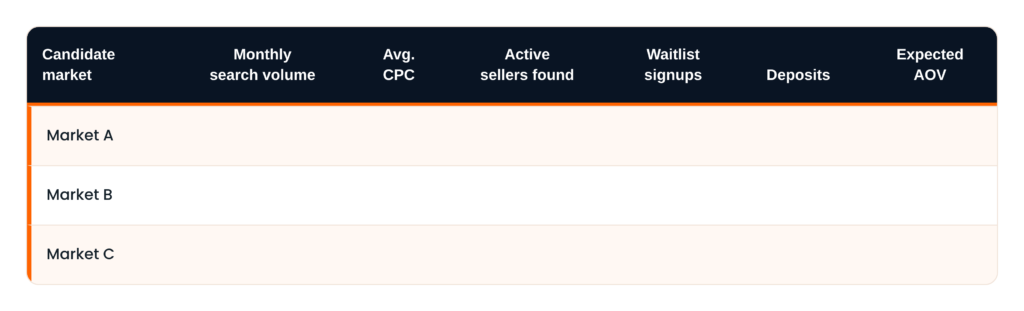
Deliverable: one chosen launch market, a raw seller list and a warm buyer waitlist. If every candidate shows near-zero localised volume and no deposits, widen the geo or the category and rerun the test. A week’s test budget buys you that answer. A quarter of paid acquisition into the wrong market costs far more.
Step 2 (Land): How do you recruit the first sellers?
Treat supply acquisition as an outbound sales motion. Build a seller lead list inside your launch market, qualify it against a seller ICP, and work it with a DM, WhatsApp and call sequence. The demand data from Step 1 is your pitch. Onboard each seller white-glove so their listings go live within a day.
For physical goods and local services, Instagram already works as an informal supply directory. Independent sellers post inventory and prices and take orders over DMs before any marketplace organises them. For B2B or digital marketplaces, the same role falls to LinkedIn, niche Slack and Discord communities, and industry directories.
How to run it:
- Define your seller ICP. For example: posted or sold in the last 30 days, has stock or capacity, already takes orders over DM or WhatsApp, delivers inside your geo-fence, prices inside your band.
- Build the lead list. Scrape hashtag and location results with Apify or PhantomBuster, add Google Maps and directory listings, then enrich each lead with phone number, WhatsApp availability, follower count and posting frequency in Clay or a shared sheet. Score each lead against the ICP.
- Run a three-touch outbound sequence. Day 1: Instagram DM. Day 2: WhatsApp follow-up with your demand proof, for example “320 people searched for furniture rental in Bandra last month and 45 joined our waitlist.” Use your real Step 1 numbers. Day 4: a call. Track reply rate and onboarding rate per touch so you know which channel to scale.
- Make an offer sellers care about. Common launch incentives: zero take rate on the first set of orders, free listing setup and photography, and guaranteed first orders from your waitlist.
- Onboard white-glove. Your team writes the listings, sets pricing with the seller, uploads photos and gets seller approval. Every form field you remove from seller onboarding raises the number of sellers who go live.
- Hold the geo-fence. Sellers two neighbourhoods over or one category away dilute supply density. Park them on a seller waitlist for Expand.
Deliverable: a set of anchor sellers with live listings. Set a supply coverage target before you start outbound, such as a minimum number of in-stock options per core buyer search, and move to Step 3 when you hit it.
Step 3 (Initiate): How do you run the first transactions manually?
Open demand only after supply is live. Activate your waitlist, hand-match every buyer request to a seller over WhatsApp, collect payment on-platform through a payment link, and log every step. This concierge phase, often called a concierge MVP, gets you paid orders and gives your product team a tested matching process to automate later.
How to run it:
- Turn on demand inside the same geo-fence. Message the waitlist first, then add geo-targeted Meta ads and local community channels: housing society WhatsApp groups, neighbourhood Facebook groups, city subreddits, or Nextdoor in the US.
- Route every request to one ops inbox. A WhatsApp Business number plus a shared Airtable base is enough at this stage.
- Hand-match each request. Shortlist two or three sellers, send the options to the buyer and confirm the order with the seller.
- Collect payment on-platform. Send a Razorpay or Stripe payment link so GMV and your take rate flow through you. Deals that move off-platform (leakage) give you no revenue and no data.
- Log every request. Record request time, match time, options sent, accepted or dropped, order value, fulfilment status and the drop reason. This log gives you fill rate, time to match and a ranked list of why orders fail.
- Ask for a review after every fulfilled order. You need these for buyer conversion and for the seller pitch in Expand.
Deliverable: first paid, fulfilled orders and a written matching playbook. The playbook becomes the spec for whatever your product team automates, so engineering builds a process that already works.
Step 4 (Confirm): How do you know a launch market is liquid?
A launch market is liquid when buyers find what they search for and come back to buy again without your ops team pushing the order. Tag every order as ops-assisted or organic from day one. Keep signups, app installs and registered users off this dashboard, because none of them tell you whether transactions happen.
| Metric | How to calculate it | What it tells you |
| Fill rate (match rate) | Requests that convert to a paid order ÷ total requests | Whether supply covers demand |
| Time to match | Time from buyer request to confirmed order | Whether buyers wait too long and drop |
| Organic order share | Orders with zero ops touch ÷ total orders | How much of the market runs without you |
| Buyer repeat rate | Buyers with 2+ orders in 30 or 60 days ÷ buyers with 1+ order | Whether buyers come back |
| Seller utilisation | Sellers with at least one order this week ÷ live sellers | Whether sellers earn enough to stay active |
| Contribution per order | Take-rate revenue minus variable costs (ops time, incentives, payment fees) | Whether the market can pay for itself |
Exit criteria: write them down before launch. Voxturr’s minimum bar is two or more repeat transactions that complete with no manual push, across more than one buyer-seller pair. Add your own fill rate and seller utilisation targets on top of that.
Signs a market has stalled:
- Your ops team still messages a buyer or seller on every order.
- Seller utilisation drops week on week. Sellers without orders churn first, and you paid the most to acquire them.
- Demand spend rises while fill rate stays flat. That points to a supply gap, so fix supply before you buy more traffic.
Step 5 (Expand): When and where do you open the next market?
Open the next market only after the first one passes your Confirm criteria. Pick an adjacent market that reuses what you already have: the next neighbourhood, the next price band or the next sub-category. Rerun Size, Land and Initiate using the playbook, reviews and order data from market one.
How to run it:
- Rank adjacent markets. Score each on seller overlap, shared buyer audience and delivery logistics. The market that reuses the most of your existing supply and audiences goes first.
- Upgrade the seller pitch. Replace search-volume projections with real order data and reviews from market one. Sellers sign faster when you can show them GMV other sellers already earned.
- Reuse your acquisition assets. Carry over the ad creatives, lookalike audiences, outbound scripts and onboarding checklist that worked.
- Benchmark time to liquidity. Track how many weeks market two takes to hit Confirm against market one. If it takes longer, check your adjacency choice before you open a third.
- Open one market at a time. Launching several at once multiplies that $150 supply CAC across all of them before any single market produces the proof that makes the next one cheaper.
How did Airbnb and OpenTable solve the cold start problem?
Both ran a version of SLICE by hand. Airbnb timed its early launch around one high-demand event in one city and later had its founders photograph New York listings themselves, which is white-glove supply onboarding. OpenTable sold standalone reservation software to San Francisco restaurants and built restaurant supply years before the diner side of its marketplace existed.
Founders in 2026 can run Size and Land faster than either team could. Localised keyword data turns market sizing into a few days of work, and public Instagram, Google Maps and directory listings put a seller lead list in front of you before you send a single message. Acquisition costs more than it did for either company, so a wrong guess on which market to seed costs more too.
Frequently asked questions
Which side should I seed first, supply or demand?
In most marketplaces, seed supply first. Buyers expect inventory to exist when they arrive, and 2026 benchmarks put supply CAC at roughly five times demand CAC, so supply needs the budget. Check this in Step 1. In some categories buyer demand is the scarce side, and the Size data will show it.
How narrow should the first launch market be?
Narrow enough that your team could match every order by hand: one neighbourhood, one price band or one sub-category. If your ops team couldn’t personally handle the first month of requests, shrink the market.
What if the marketplace is fully digital and has no Instagram supply?
Keep the sequence and change the sourcing channel. LinkedIn, niche Slack and Discord communities, and existing industry directories show you where digital sellers and service providers already operate. Build the lead list there and run the same outbound sequence.
How long should we stay in concierge mode?
Stay in concierge mode until the market passes your Confirm criteria. If you automate matching before you see organic repeat orders, you hard-code the chicken-and-egg problem into the product and still have to solve it.
Run SLICE with a team that has done it
Founders who stay stuck longest usually spend two quarters on ad tests and onboarding rewrites when the real issue is sequencing. Voxturr’s pre-launch marketing team runs the Size and Land diagnostic before any budget goes out, so your first spend decision is which market to seed.