Key Highlights
- Performance marketing judges D2C campaigns on revenue, so ROAS, CAC, conversion rate, lifetime value and repeat purchase rate matter more than reach.
- Growth stalls when acquisition costs rise, creatives wear out and discounts erode margin.
- First-party data and AI targeting cut wasted spend, and hyper-local targeting helps in Tier 2 and Tier 3 cities.
- Creator content works best when it is treated as conversion creative.
- Every channel needs a clear job, and weekly reviews move the budget toward what works.
- Retention is where profit comes from, because a repeat purchase needs no new acquisition spend.
Introduction: The Shift in D2C Growth Strategy
The Indian D2C ecosystem has changed quickly. Digitally native brands that once disrupted traditional retail now compete in a crowded market, and acquisition costs keep rising while attention splits across too many screens. As a result, broad advertising and influencer deals alone no longer scale a brand profitably. More founders are therefore turning to performance marketing as a structured growth engine.
Performance marketing for D2C is no longer just paid ads on Meta or Google. Instead, it combines first-party data, AI-driven targeting, creator-led content, a clear channel plan and retention. Brands that run it this way increasingly reach 5x revenue growth, and they do it without giving up acquisition efficiency or customer lifetime value.
That growth is real. Objective Nutrients, a functional nutrition brand, grew revenue from $700K to more than $4M in 24 months with Voxturr, through 100+ campaigns across Amazon, Meta, Google and TikTok and a 6.5+ ROAS on Amazon Ads. The pattern behind that result is the one this guide covers.
At Voxturr, we treat performance marketing as revenue infrastructure rather than a string of campaigns.
Why Most D2C Marketing Strategies Eventually Slow Down
Many D2C brands start strong on paid social, influencer partnerships and promotional pricing. Over time, however, the model shows its limits. Platform competition pushes acquisition costs up, creative fatigue pulls conversion rates down, and heavy discounting eats into margins. Revenue keeps growing, but profit does not keep pace.
The plateau usually comes from optimising for visibility instead of revenue. When campaigns are judged on impressions, reach or engagement, a brand loses sight of what actually drove sales. Performance marketing changes the question, because it asks how many people bought, at what cost and how long they stayed.
The Core of D2C Performance Marketing: Revenue-Centric Metrics
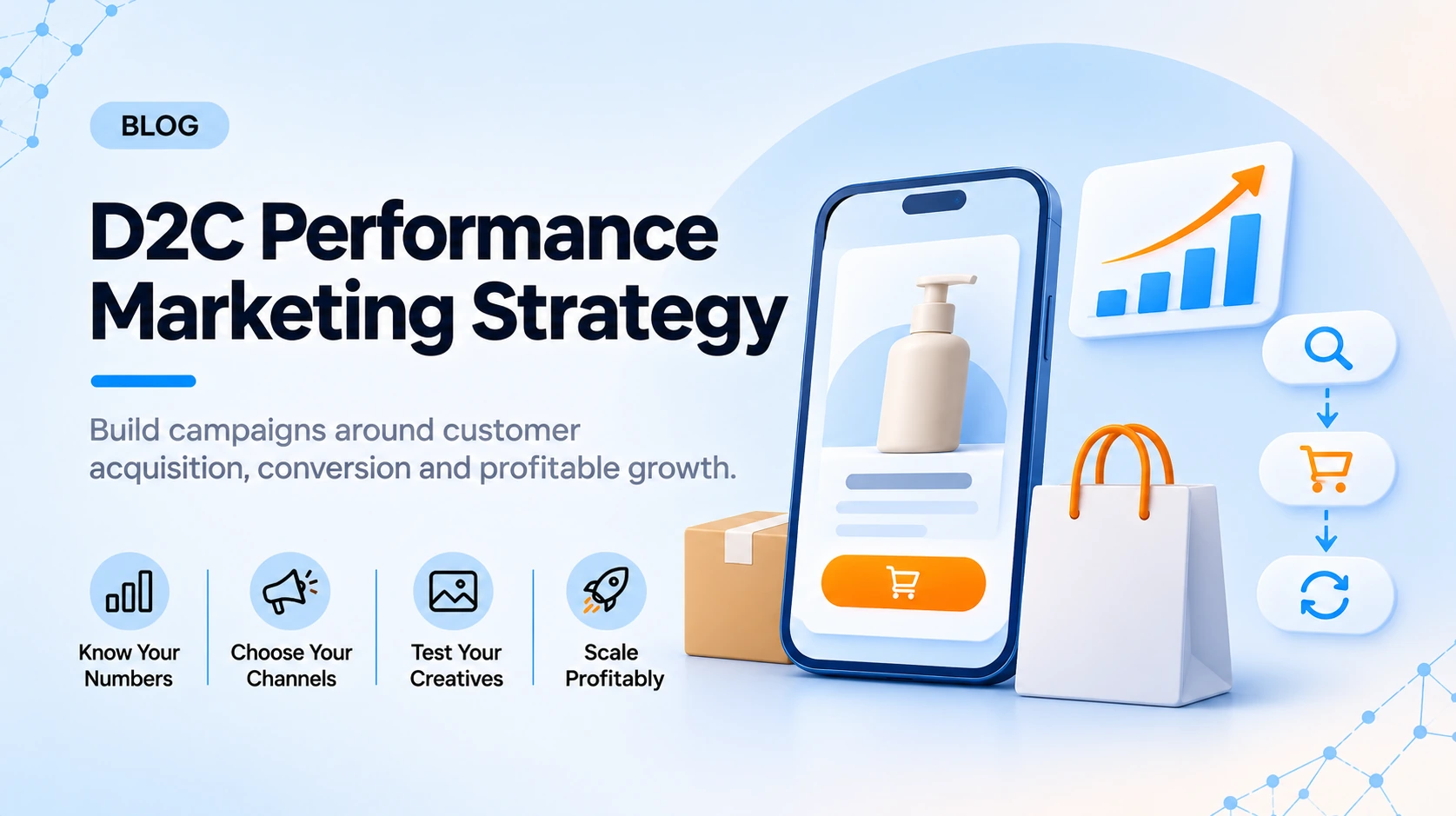
Strong D2C teams track five numbers that connect to business outcomes: Return on Ad Spend (ROAS), Customer Acquisition Cost (CAC), Conversion Rate (CVR), Customer Lifetime Value (LTV) and Repeat Purchase Rate. When they watch these consistently, budget decisions turn from reactive to strategic.
Budgets show the difference most clearly. A brand that tracks LTV puts money behind high-value segments rather than raising spend on every campaign. It tests creatives and scales only the best converters. It also builds lifecycle automation into the first purchase instead of treating acquisition and retention as separate jobs.
This discipline separates brands that reach 5x from brands that stall.
Performance Marketing Built for D2C Scale
We run the creative testing, media buying and measurement that drive multi-fold D2C revenue growth, with unit economics visible at every step.
First-Party Data as the Growth Foundation for D2C Brands
Privacy rules are tightening and third-party cookies are fading, so first-party data has become the most valuable asset a D2C brand owns. Performance marketing in 2026 and beyond depends on how well a brand collects, structures and activates its own customer data.
First-party data covers website behaviour, purchase history, CRM records, email engagement, app activity and subscription behaviour. Once it is organised, a brand can segment customers by what they do rather than by broad demographics. As a result, acquisition waste falls and retention efficiency rises at the same time.
AI-Driven Targeting and Hyper-Local Performance Scaling
Once the data is in order, AI works as a force on top of it. Platforms can build predictive lookalike audiences from high-LTV cohorts, and churn models can trigger retention campaigns before a customer drifts. They can also shift budget toward winning campaigns in real time.
Hyper-local targeting works particularly well in India, because Tier 2 and Tier 3 cities contribute a growing share of e-commerce growth. When AI targeting lines up with localised messaging and fulfilment capacity, acquisition costs tend to fall.
Creator-Led Content as a Performance Asset
Influencer marketing has long been part of D2C, but the way it fits into performance marketing has changed. High-growth brands now treat creator content as conversion creative, not only as awareness.
Micro-creators often earn more engagement and trust than celebrity endorsements. Therefore, when their content is cut into paid formats, matched to funnel stages and paired with shoppable landing pages, it becomes a measurable revenue driver.
Multi-Channel Integration in D2C Performance Marketing
Consumers rarely convert on their first interaction with a brand. Awareness may start on Instagram, intent may form through Google search, and the purchase may happen after a remarketing ad or an email. For this reason, performance marketing needs these touchpoints to work together.
A good plan gives each channel a clear job. Meta drives discovery and engagement, while Google captures high-intent search. YouTube builds product understanding, and email and SMS reinforce retention. Affiliate and creator networks then widen reach.
Order matters too. High On Chicken, a D2C food brand, launched its WooCommerce site and Meta Ads together and watched ROAS until the site proved it could convert. Only then did Amazon get budget. Meta reached 3.5+ ROAS in under 60 days, and the brand scaled its channel mix to INR 300K in monthly revenue, as the High On Chicken case study describes.
Continuous Optimization and Revenue Compounding
Performance marketing thrives on iteration. Weekly reviews look at ROAS by channel, CAC by audience segment, conversion rate by creative and LTV by acquisition source. After each review, weak campaigns are paused and strong segments get more budget.
Small gains in conversion rate or CAC compound over several months, so some D2C brands reach 5x growth without a proportional rise in ad spend. In the end, discipline in optimisation, more than aggressive scaling, makes D2C growth last.
Case Study: Scaling a D2C Skincare Brand with Voxturr and Voxturr Labs
A D2C skincare brand, whose name we keep private, came to Voxturr with rising acquisition costs and inconsistent repeat purchases. Despite strong engagement, revenue growth had slowed.
The initial audit found broad targeting, limited first-party segmentation and weak retention workflows. Voxturr then built a performance framework around behavioural segmentation, AI-led lookalike modelling based on high-LTV customers and creator-led creative testing.
Hyper-local targeting lined campaigns up with warehouse fulfilment zones to reduce delivery friction. At the same time, automated lifecycle email and SMS flows raised repeat purchase frequency.
Within six months, the brand saw a substantial drop in CAC, better repeat purchase rates and strong subscription adoption. Revenue grew to close to five times the baseline quarter, and the growth came from structured optimisation rather than heavy discounting.
Retention Strategy as the Profit Multiplier
Acquisition brings customers in, but retention is where the profit comes from. D2C brands with subscription programmes, loyalty incentives, tailored product recommendations and post-purchase automation tend to do better than brands that only chase new customers.
Even a small rise in repeat purchase rate can lift lifetime value sharply. When retention is built into the acquisition model from day one, profitability improves without a matching rise in marketing spend.
Rooted Active Naturals shows how this looks in practice. Voxturr set up WhatsApp automation on Interakt that recovered 55% of abandoned carts, which the case study describes as over half the carts that would otherwise have been lost. The brand also became a top-rated seller in its Amazon category.
Emerging Trends in D2C Performance Marketing for 2026
AI-generated dynamic creatives will shorten content production timelines, and voice and conversational commerce will open new discovery channels. Social commerce will also shorten purchase journeys, while sustainability-led messaging will keep influencing consumer decisions. Above all, first-party data ownership will become the base of advertising success.
D2C brands that pair these trends with disciplined performance systems will hold a lasting advantage.
Conclusion: Performance Marketing as Revenue Infrastructure
D2C brands reaching 5x revenue growth are not leaning on isolated campaigns or viral spikes. Instead, they build performance infrastructure rooted in data, AI-enabled targeting, creator integration, coordinated channels, steady optimisation and retention.
At Voxturr, we treat performance marketing as revenue architecture rather than media buying. Because acquisition costs keep rising, disciplined measurement and execution are the safest route to growth. Growth is no longer about reach alone. It is about systems that convert, retain and compound revenue. If you want to see how this would work for your brand, talk to our team.
Frequently Asked Questions
What is D2C performance marketing?
D2C performance marketing is a data-driven digital marketing strategy where direct-to-consumer brands optimise campaigns based on measurable metrics such as return on ad spend, customer acquisition cost and lifetime value rather than impressions or reach.
How can D2C brands reduce customer acquisition cost?
Brands reduce acquisition cost by using first-party data segmentation, AI-powered audience targeting, hyper-local campaigns, conversion-optimised creatives and continuous budget optimisation.
Why is retention important for D2C revenue growth?
Retention increases customer lifetime value and improves profitability. Even small improvements in repeat purchase rates can significantly enhance long-term revenue growth for D2C brands.
What role does AI play in D2C performance marketing?
AI helps D2C brands automate audience targeting, predict churn, optimise ad spend allocations, personalise creative content and improve campaign efficiency at scale.
What ROAS should a D2C brand aim for?
There is no single target, because it depends on margin, price and repeat purchase rate. First, work out your break-even ROAS, which is 1 divided by your gross margin, and then set the target above it. For reference, Voxturr’s published D2C results include 3.5+ ROAS on Meta in under 60 days for High On Chicken and 6.5+ on Amazon Ads for Objective Nutrients.