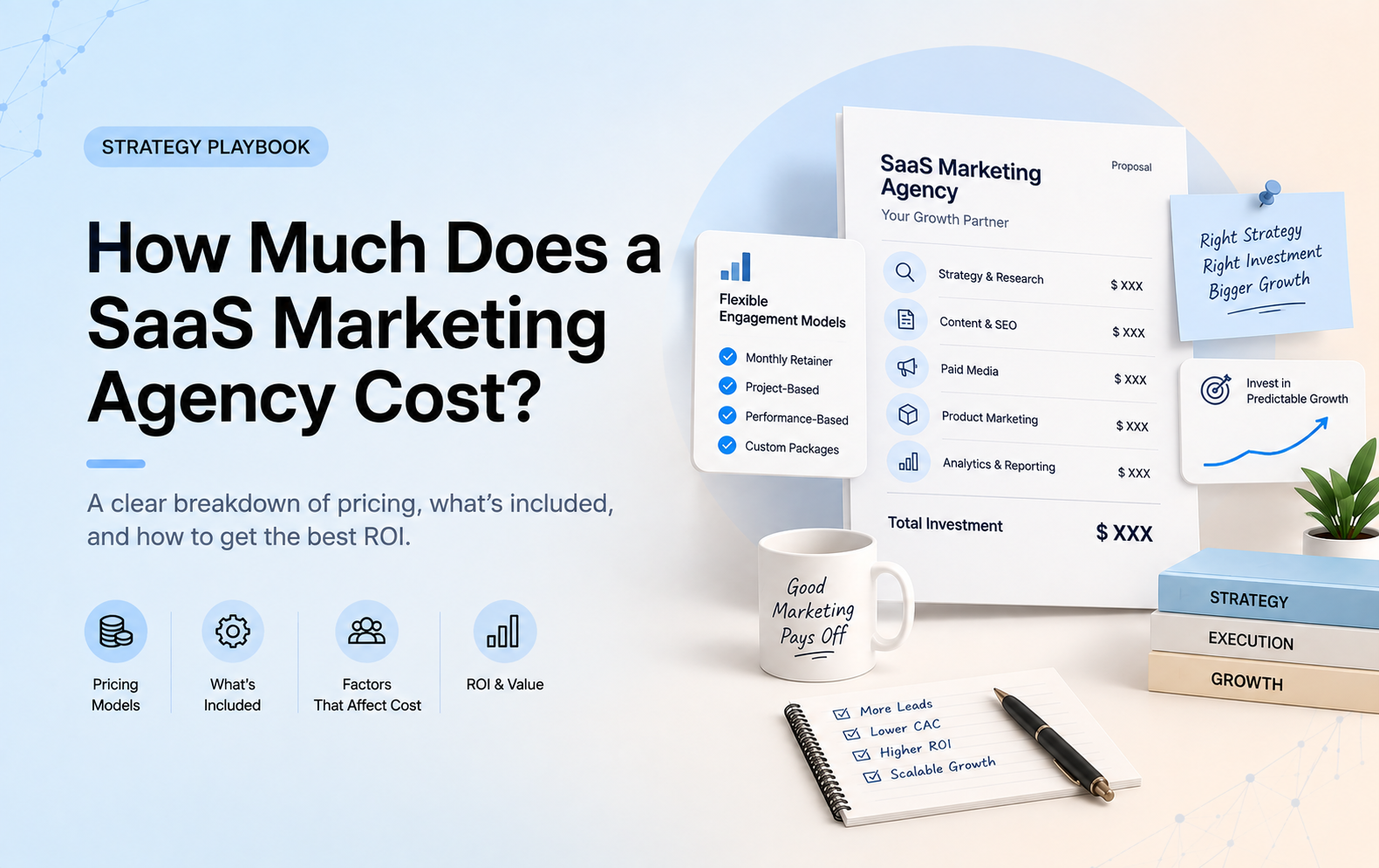
Having worked with 150+ brands, we’ve built this guide around the questions companies and startups ask most often when evaluating SaaS marketing investments. It covers the key considerations and provides practical answers to help you make informed decisions.
The cost of a SaaS marketing agency depends on your company’s growth stage, marketing goals, required services, and the level of expertise involved. Early-stage companies may need focused support for one or two channels, while growth-stage and enterprise SaaS companies often require broader, full-funnel programs with dedicated strategy, execution, and reporting.
Since 2018, Voxturr has worked with SaaS and technology companies including HighRadius, Freshworks, Automation Anywhere, KredX, CashFlo, Zimyo, CleverTap, Amazon AWS, Akenza and others, helping teams build and scale their growth programmes. Drawing on that experience, this guide explains what different pricing levels actually deliver, how to evaluate a SaaS marketing proposal, and where pricing and scope can often go wrong.
The table below shows what each band includes.
| Stage | Typical ARR | Monthly retainer | What’s usually included |
| Early-stage | Pre-seed to ~$1M ARR | $1,250 to $8,000 | 1 to 2 channels, foundational SEO/content, shared account team |
| Growth-stage | $1M to $10M ARR | $8,000 to $20,000 | Multi-channel demand gen, dedicated strategist, monthly reporting |
| Enterprise | $10M+ ARR, multi-product | $20,000 to $50,000+ | Full-funnel program, account-based marketing, senior leadership, custom attribution |
Voxturr’s SaaS marketing guide covers the full growth playbook this pricing sits inside. From our experience working with SaaS and B2B growth programs, the retainer only makes sense when viewed against the stage of the business, the channels involved, and the level of expertise required. The rest of this piece breaks down what actually drives the number on your invoice, so you can tell a fair quote from an inflated one before you sign anything.
What determines how much a SaaS marketing agency costs?
The price of SaaS marketing rarely comes down to a single number. What matters is what the engagement needs to accomplish at your current stage of growth.
Stage sets the band, but three things move the price inside that band: scope, seniority, and channel mix. A $5,000/month retainer covering one channel and a shared account manager isn’t comparable to a $20,000/month retainer covering strategy, content production, paid media, and a dedicated senior team, even though both get labeled “SaaS marketing agency.”
From our experience managing SaaS growth programs, this is where pricing comparisons often lose context. The investment changes because the marketing problem changes. A company establishing its initial acquisition channels has different requirements from a growth-stage SaaS business building multi-channel demand generation, and an enterprise program introduces another level of funnel complexity and attribution.
● Scope. How many channels (SEO, paid, content, demand gen, lifecycle) sit inside the fee.
● Seniority. A dedicated strategist costs more than a junior account manager routing work to a shared pod.
● Channel complexity. Single-channel paid search costs less to run than a multi-platform program with conversion optimization and CRM integration layered on top.
How much does SaaS marketing cost by service type?
The service you choose can influence the investment just as much as the stage of your SaaS company. Different marketing functions require different levels of specialization, resources, and execution.
Cost varies as much by service as it does by stage. SEO and content retainers run $3,000 to $15,000/month. Marketing automation implementation is a separate line item, typically $7,500 to $30,000 depending on system complexity. Brand repositioning work runs $10,000 to $50,000. Website or campaign projects run $7,000 to $100,000+ per project.
| Service | Typical cost | Billing type |
| SEO / content retainer | $3,000 to $15,000/month | Monthly retainer |
| Marketing automation implementation | $7,500 to $30,000 | One-time project |
| Brand repositioning | $10,000 to $50,000 | One-time project |
| Website redesign / campaign build | $7,000 to $100,000+ | One-time project |
| Hourly consulting (generalist agency) | $75 to $170/hour | Hourly |
| Hourly consulting (SaaS specialist) | $150 to $250/hour | Hourly |
Figures for retainers and automation come from Rightleft Agency’s 2026 SaaS marketing cost guide; hourly rates and project ranges come from TripleDart’s 2026 breakdown. The specialist premium on hourly rates reflects domain knowledge an SEO-only or generalist agency doesn’t have: how SaaS buying cycles work, what expansion revenue means for a campaign’s real ROI, and where subscription businesses lose pipeline that ecommerce or B2B services businesses don’t.
In practice, that specialization affects how marketing work is planned and evaluated. SaaS programs have to account for the longer buying cycle, the relationship between acquisition and expansion, and the pipeline impact of different channels. The higher specialist rate therefore reflects the depth of business-model knowledge brought into the strategy, alongside the execution itself.
What are the SaaS marketing agency pricing models?
How an agency charges can change how you plan your marketing investment. The right model depends on whether you need continuous execution, a defined project, or a structure tied to measurable performance.
Most SaaS marketing agencies price their work one of four ways: monthly retainer, project-based fee, percentage of ad spend, or performance-based/hybrid pricing. Retainers dominate the market, because ongoing SaaS growth work rewards continuity over one-off sprints.
| Pricing model | Typical range | Best for | Watch out for |
| Monthly retainer | $1,250 to $50,000+/month | Ongoing SEO, content, demand gen, fractional CMO work | Vague deliverables turn a retainer into a “relationship fee” with no accountability |
| Project-based | $7,000 to $100,000+ per project | GTM audits, website relaunches, one-time campaign builds | Scope creep: a project that grows without a matching price adjustment |
| Percentage of ad spend | 10 to 20% of managed media budget | Paid acquisition-heavy programs | Misaligned incentives: the agency earns more the more you spend, regardless of efficiency |
| Performance-based / hybrid | Base retainer plus bonus tied to KPIs | Later-stage SaaS with clean attribution | Only works if the metric is qualified, attributable, and inside the agency’s actual control |
An August 2026 analysis from Understory cites Credo’s agency pricing survey: almost every agency offers a retainer option, roughly half set their minimum at $2,000/month or lower, and about 1 in 7 set it above $5,000/month. Treat that as a signal, not a floor. A $2,000 minimum buys a fraction of a channel, not a program.
What percentage of revenue should SaaS companies spend on marketing?
Marketing investment as a share of ARR falls as a company matures, which is a second way to sanity-check any quote beyond the flat dollar bands above. Early-stage SaaS companies typically invest 12 to 25%+ of ARR in marketing, growth-stage companies invest 10 to 20%, and mature companies invest 5 to 15%, according to Rightleft Agency’s 2026 SaaS marketing cost guide.
This figure covers total marketing investment, not agency fees alone, so it includes media spend, tooling, and internal headcount alongside whatever an agency bills. When reviewing a quote, the more useful question is how the total marketing investment fits the company’s stage and growth priorities. If your total marketing spend as a percentage of ARR is well outside these bands in either direction, that’s worth a second look before you sign a new retainer, not after.
Retainer vs. project-based: which should you pick?
The decision becomes simpler when you start with the nature of the work rather than the pricing model. Ongoing growth programs and defined marketing projects serve different purposes.
Pick a retainer if the work is ongoing. SEO, content, and demand gen all compound and need continuous optimization, not a one-time push. Pick project-based pricing if the deliverable is clear and finite: a GTM audit, a website rebuild, a single campaign launch. A good agency tells you which model fits your stage instead of defaulting to whichever pays them more predictably.
Retainers reward an agency for staying with you. Institutional knowledge about your product, your ICP, and your competitive landscape compounds, so month six of work is usually sharper than month one. Project fees reward an agency for finishing: you know exactly what you’re getting and when it ships, but every new initiative means a new scope conversation and a new quote. Retainers tend to win on an annualized basis for companies that need continuous execution, since a string of one-off projects usually costs more in total than one ongoing relationship covering the same work.
What ROI should that spend produce?
Marketing cost becomes meaningful only when you understand what the investment is expected to contribute to the business. For SaaS companies, that means looking beyond activity volume and connecting marketing work to measurable growth.
Cost only means something next to what it returns. B2B SaaS content marketing produces roughly 844% ROI over three years, and B2B SaaS SEO produces roughly 702 to 748% ROI with break-even typically reached in 7 to 9 months, per SaaSHero’s 2026 B2B SaaS marketing benchmark data. LinkedIn cost-per-lead for B2B SaaS typically runs $60 to $150, and can exceed $200 for enterprise targeting.
Use these as a floor for judging a proposal, not a promise any specific agency will hit them. From a SaaS growth perspective, the important question is how the proposed work connects marketing activity to pipeline and measurable business outcomes. Ask any agency how they attribute pipeline to their work before you compare their price to anyone else’s.
What’s a fair price for a SaaS marketing agency in 2026?
A fair price is easier to identify when you can trace the investment back to the work being performed. The headline retainer matters, but the scope behind it matters more.
The right question is whether the agency’s fee aligns with a specific, itemized scope that fits your company’s stage, goals, and channel mix. Ask for the full annual cost upfront, including agency fees, media spend, marketing tools, content production, and any additional project charges, along with the monthly retainer.
Some agencies quietly cost more than the headline number suggests. They price the retainer low, then bill separately for analytics setup, landing pages, creative, or “strategic add-ons” that actually move the pipeline. Long contract lock-ins and junior account management on a senior-priced retainer are the two most common red flags worth asking about directly before you sign.
From our experience with SaaS and B2B growth programs, a useful proposal should make the relationship between investment and scope easy to understand. You should be able to see what the team is responsible for, what level of expertise is involved, and why that scope makes sense for your current stage.
How Voxturr prices SaaS marketing work
At Voxturr, pricing starts with the growth requirement rather than a predefined package. The scope, stage, channels, and strategic involvement determine what the engagement needs to look like.
Voxturr runs demand generation, SEO, and full-funnel SaaS marketing programs for companies like HighRadius, KredX, CashFlo, Zimyo, and Akenza, and prices every engagement against a defined scope and stage rather than a flat “package” tier. A growth-stage retainer covering three channels and senior strategy costs more than an early-stage retainer covering one channel, and the proposal shows exactly why. That’s the standard this guide argues for: the number on your invoice should trace to a specific list of deliverables and your actual stage, not a brand name. See how Voxturr structures SaaS marketing retainers and project pricing on the SaaS marketing agency pricing page.
FAQ
What is the typical pricing for a SaaS marketing agency?
A SaaS marketing agency typically costs $1,250 to $50,000+ per month, depending on your growth stage, scope, and marketing requirements. Early-stage companies generally fall toward the lower end, while enterprise SaaS businesses with broader programs can invest $20,000 to $50,000+ per month.
Is a SaaS marketing agency worth the cost compared to hiring in-house?
Often, yes, on a pure cost basis. A single in-house SaaS marketer typically costs $80,000 to $150,000 a year in salary alone, before benefits and tools, while an agency retainer can provide a small team across multiple channels.
Do SaaS marketing agencies charge setup fees?
Some do, especially for analytics or CRM implementation work that sits outside the ongoing retainer. Ask upfront whether onboarding, tracking setup, or a strategy sprint is billed separately or bundled into month one.
How long is a typical SaaS agency contract?
Most retainers run month-to-month after an initial 3 to 6 month commitment, since SEO and demand gen need that runway to show real signal. Be cautious of any agency asking for a 12-month lock-in before you’ve seen a single month of results.
What’s the difference between a SaaS marketing agency and a general digital marketing agency?
A SaaS-specialist agency builds its playbook around subscription metrics: CAC, LTV, pipeline, and expansion revenue, instead of generic lead volume. That specialization shows up in the price. SaaS-focused agencies charge $150 to $250/hour versus $75 to $170/hour for generalist agencies, because the strategy work is more specific to your business model.
What should I check before signing a contract with a SaaS marketing agency?
Look beyond the quoted retainer and review the scope, team seniority, channels covered, reporting, additional costs, and contract terms. A strong proposal should make it clear what you are paying for and how the work connects to your SaaS growth objectives.
What does Voxturr do?
Voxturr is a growth marketing agency founded in 2018, with offices in San Francisco and Gurugram. The agency has worked with more than 150 companies across the US, India, Europe, Canada, Singapore, ANZ, and the UAE on SaaS, B2B, fintech, ecommerce, and D2C growth programs.